Rome Metro C Expansion: 2 New Stations Now Open
Rome’s Metro Line C: Connecting History, People, and Sustainability
Rome’s Metro Line C is one of the most ambitious urban mobility projects in Europe — blending advanced transport technology with the city’s extraordinary archaeological heritage. After decades of planning, careful excavation, and construction challenges, the line continues extending deeper into Rome’s historic core and connecting it more effectively with its suburbs.
What Makes Line C Special?
1. A Major Mobility Upgrade
Line C dramatically improves access between Rome’s south-east suburbs and the city centre, offering a faster, more reliable alternative to buses and cars. The metro represents a significant expansion of Rome’s rapid transit network, nearly doubling the current metro coverage and greatly enhancing the city’s public transport “network effect.”
2. Sustainability and Reduced Pollution
By offering a high-capacity alternative to private cars and buses, Line C helps reduce traffic congestion and air pollution. For the stretch from San Giovanni to Colosseo – Fori Imperiali, estimates suggest a reduction in CO₂ emissions of around 34,000 tonnes per year from decreased private car use.
3. Economic and Urban Regeneration
Improved accessibility often stimulates local economic activity — bringing customers closer to small businesses, encouraging new jobs, and strengthening neighbourhood economies. Some studies suggest investments in public transit infrastructure are correlated with a rise in economic activity near stations.
4. Innovative Engineering
Line C is Rome’s first driver-less metro line, equipped with modern safety systems like automatic platform doors and centralized train control. Its construction also features leading-edge techniques such as top-down archaeological excavation to preserve historical layers while building deep underground.
Route and Key Stations
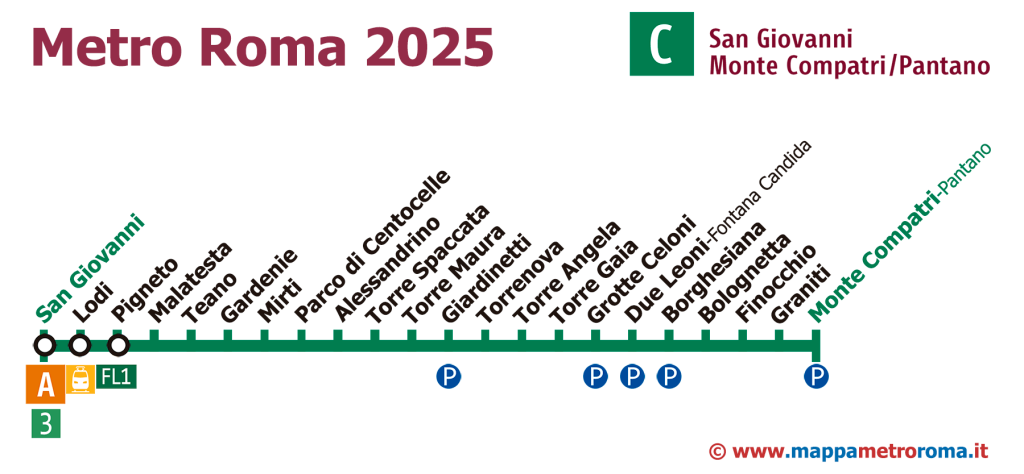
Here’s a station-by-station look at the current Line C route — from southeast to northwest — including the newest additions and planned extensions.
Current Operational Section
This branch connects the outer suburb of Monte Compatri/Pantano with the heart of the city centre:
Monte Compatri/Pantano (terminus)
Graniti
Finocchio
Bolognetta
Borghesiana
Due Leoni/Fontana Candida
Grotte Celoni
Torre Gaia
Torre Angela
Torrenova
Giardinetti
Torre Maura
Torrespaccata
Alessandrino
Parco di Centocelle
Gardenie
Teano
Malatesta
Pigneto
Lodi
San Giovanni (connection with Line A)
New Central Stations
Recent openings significantly bring the line into the historic core:
Porta Metronia — Museum-station highlighting ancient structures and artefacts discovered on site.
Fori Imperiali / Colosseo — Major cultural hub with archaeological displays and an interchange with Metro Line B.
Future and Planned Extensions
These will further extend Line C into central and northern Rome:
Venezia — deep underground station near Piazza Venezia, integrating archaeological finds with city landmarks.
Chiesa Nuova
San Pietro
Ottaviano (planned transfer with Line A)
Clodio/Mazzini
Auditorium (planned)
Farnesina (planned)
Once completed, Line C will stretch even further, eventually connecting important cultural and transit hubs from the Vatican area to the northwestern suburbs.
Cultural and Tourist Benefits
What makes Rome’s Line C particularly unique is the integration of history and transit. Stations like Porta Metronia and Colosseo aren’t just stops — they’re museum-like experiences, where commuters and visitors can see and learn about artefacts uncovered during construction. This blending of transport and cultural heritage is unprecedented in urban metro projects worldwide.
Rome’s Metro Line C is more than a transportation project — it’s a transformative urban infrastructure, enhancing sustainability, mobility, economic growth, and cultural experience. By connecting the suburbs with the historic centre and revealing the city’s past within its stations, Line C reflects Rome’s unique challenge: modernizing transport while honouring millennia of history.